
If your child is four years old and either just starting school or about to, phonics is probably already on your radar. It can feel a little daunting from the outside — there’s a lot of terminology, a lot of different approaches, and a lot of conflicting advice online.

The good news is that supporting phonics at home doesn’t need to be complicated. Some of the most effective activities are also the simplest, and most of them feel more like play than learning to a four year old, which is exactly how it should be at this age.
What Is Phonics and Why Does It Matter?
Phonics is the method used to teach children how sounds and letters connect. Rather than learning to recognise whole words by sight, children learn the individual sounds — called phonemes — that letters and letter combinations represent, and how to blend those sounds together to read and spell words.
It’s the approach used in the vast majority of UK primary schools and there’s strong evidence behind it. Children who have a secure understanding of phonics find reading and spelling significantly easier as they progress through school.
At four years old, most children are in the early stages — learning initial sounds, beginning to recognise letters, and starting to hear that words are made up of separate sounds. The activities below are designed with that stage in mind.

I Spy Sound Hunts
I Spy is one of the best phonics activities for young children because it requires no materials at all and can be played anywhere. The key is to play it using sounds rather than letter names — so “I spy something beginning with the sound ‘mmm'” rather than “beginning with the letter M.”
This is an important distinction at this stage. Children need to connect letters to their sounds first, and using letter names too early can cause confusion.
You can extend this at home by doing a sound hunt around the house — can your child find five things that start with the ‘s’ sound? Can they find something beginning with ‘b’ in every room?
Magnetic Letters on the Fridge
A set of magnetic letters on the fridge is one of the most useful and low-effort phonics resources you can have at home. They’re always there, always accessible, and children naturally gravitate towards them.
Use them to make simple three-letter words — cat, dog, hat, bin, cup — and sound them out together. Ask your child to change one letter to make a new word. This kind of word-building is brilliant for understanding how sounds work together.
Sound Sorting
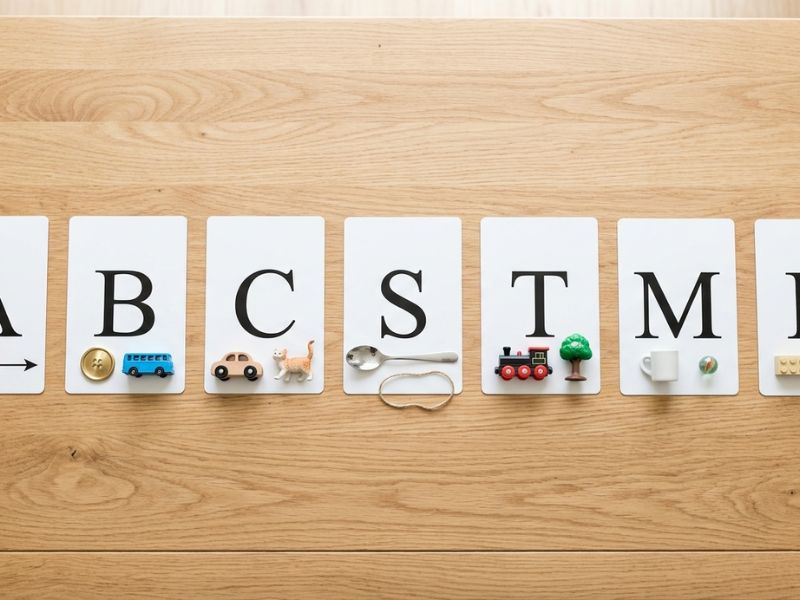
Write a few letters your child is currently learning onto separate pieces of card. Gather a collection of small objects from around the house — a button, a toy car, a spoon, a coin — and ask your child to sort them by their initial sound, placing each object on the correct letter card.
This works well as a tuff tray activity too, with the objects hidden in sand or rice for your child to find and sort.
Phonics Bingo
Make simple bingo cards with four to six pictures on each one — things like a sun, a hat, a dog, a fish, a cat, a bin. Call out the initial sound of each picture and ask your child to find and cover the matching image on their card.
This is a lovely activity to do with siblings or a small group and the game format keeps engagement high.
Playdough Letter Making
Roll out playdough and ask your child to form letter shapes with it. This works on two levels — it reinforces letter recognition visually while also building the fine motor skills needed for writing.
Keep it playful. Ask them to make the first letter of their name, or the letter that their favourite animal starts with. There’s no need to work through the alphabet in order.
Blending with Simple Word Cards
Once your child knows a handful of sounds, simple blending activities are a great next step. Write short three-letter words on cards — words like sat, pin, hot, leg, cup — and sound them out together, running your finger under each letter as you say the sound, then blending them together.
Let your child have a go at running their finger under the letters and blending the sounds themselves. The physical act of pointing while sounding out helps many children enormously.
Sound Buttons
Draw a simple picture and write the word underneath it. Draw a small dot — a sound button — under each letter. Ask your child to tap each button as they say the sound, then blend the whole word together.
This is a technique used widely in early years classrooms and it works because it slows the process down and gives children something physical to do as they decode.
Outdoor Phonics Activities
Taking phonics outside changes the energy completely for children who find sitting still difficult.
Write letters in chalk on the patio and call out a sound — your child runs to jump on the right letter. Hide picture cards around the garden and ask your child to collect everything beginning with a particular sound. Write letters in a grid and throw a beanbag — whatever it lands on, think of a word beginning with that sound.
Physical activity and learning work particularly well together at this age, and getting outside removes the pressure that can sometimes build up around more formal table activities.
Tips for Supporting Phonics at Home
Follow your child’s school’s approach. If your child has started Reception, ask their teacher which phonics programme the school uses and which sounds they’re currently covering. Reinforcing the same sounds at home makes a real difference.
Little and often works best. Five to ten minutes of phonics play a day is far more effective than a longer session once a week. Keep it short and stop before your child gets frustrated.
Always use sounds, not letter names. Say ‘sss’ not ‘ess’, ‘mmm’ not ’em’, ‘fff’ not ‘ef’. This is the single most important thing you can do to support early phonics at home.
Praise the effort, not the result. Getting sounds wrong is part of learning. Keeping the experience positive and low-pressure means your child will be far more willing to engage over time.