
If you’ve noticed your toddler isn’t talking as much as other children their age, or their speech doesn’t seem to be progressing the way you’d expect, it’s natural to feel worried. Speech development varies enormously between children, but there’s also a lot you can do at home to support your toddler’s language in a way that feels natural and low pressure.
These activities aren’t a replacement for professional support if your child needs it — but they’re genuinely effective for building language in everyday life, whether your child has a diagnosed delay or you simply want to give their communication a boost.
First, a Word on Speech Delay
Speech delay is more common than most people realise. Some children are simply later talkers who catch up quickly and independently. Others benefit from speech and language therapy to make progress. The important thing is not to wait and worry in silence — if you have concerns about your child’s speech, speak to your health visitor or GP sooner rather than later. Early support makes a real difference.
In the meantime, the activities below are recommended by speech and language therapists as effective ways to build language at home. They work for all toddlers, not just those with identified delays.
Talk Through Everything You Do
One of the most powerful things you can do for a child’s language development costs nothing and requires no preparation. Simply narrate your day as you go through it — not in an artificial way, but naturally, as if you’re just thinking out loud.
While you’re making lunch: “I’m cutting the banana. One piece, two pieces. The banana is yellow.” While you’re getting them dressed: “Here’s your jumper. It’s blue. Let’s put your arm in. There it is.”
This kind of running commentary exposes your child to vocabulary, sentence structure, and the rhythm of language in a completely natural context. It works particularly well for toddlers who aren’t yet talking much, because it removes any pressure on them to respond.
Get Down to Their Level
Communication is about connection as much as words. When you get down to your child’s physical level — sitting on the floor with them, crouching to their height — you’re making eye contact easier and signalling that you’re fully present and engaged.
This matters more than it might seem. Children are more likely to attempt communication when they feel genuinely listened to, and eye contact is a foundational skill for language development.
Follow Their Lead
Rather than directing play, try following your child’s lead and commenting on what they’re doing. If they’re pushing a toy car around the floor, you push one too and narrate what’s happening: “The car is going fast. Beep beep. It stopped.”
This approach — sometimes called child-led interaction — is one of the most evidence-based strategies for supporting early language. It keeps the child engaged, removes pressure, and models language in a context that’s immediately relevant to them.
Reduce Questions, Add Comments
It’s natural to ask toddlers lots of questions — “What’s that? What colour is it? What are you doing?” — but questions put pressure on a child to perform, which can actually reduce their willingness to communicate.
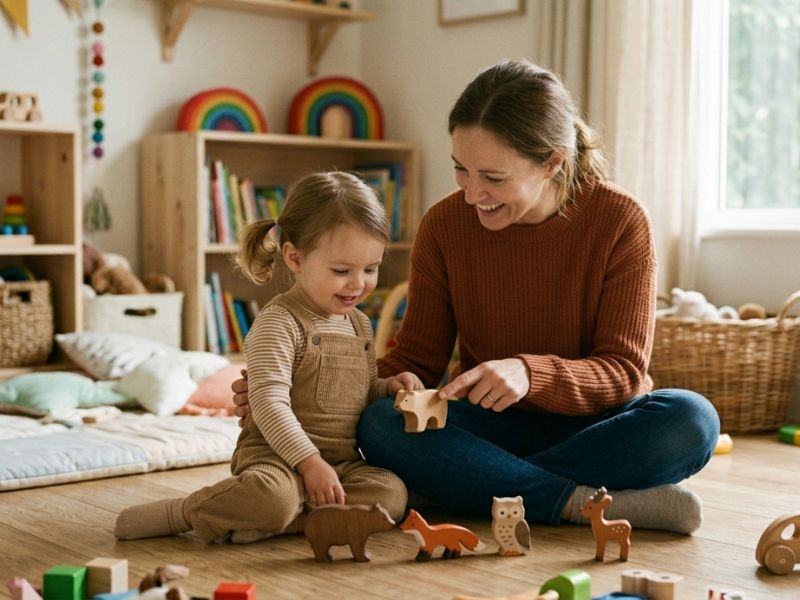
Try replacing some questions with comments instead. Rather than “What’s that?” try “Oh, it’s a dog!” Rather than “What colour is that?” try “That one’s red.” You’re still exposing them to the same vocabulary, but without the pressure of a required response.
Read Together Every Day
Reading aloud is one of the single most effective things you can do for a child’s language development, and the benefits are well established. For toddlers with speech delay, shared reading is particularly valuable because it exposes them to vocabulary and sentence structures they wouldn’t encounter in everyday conversation.
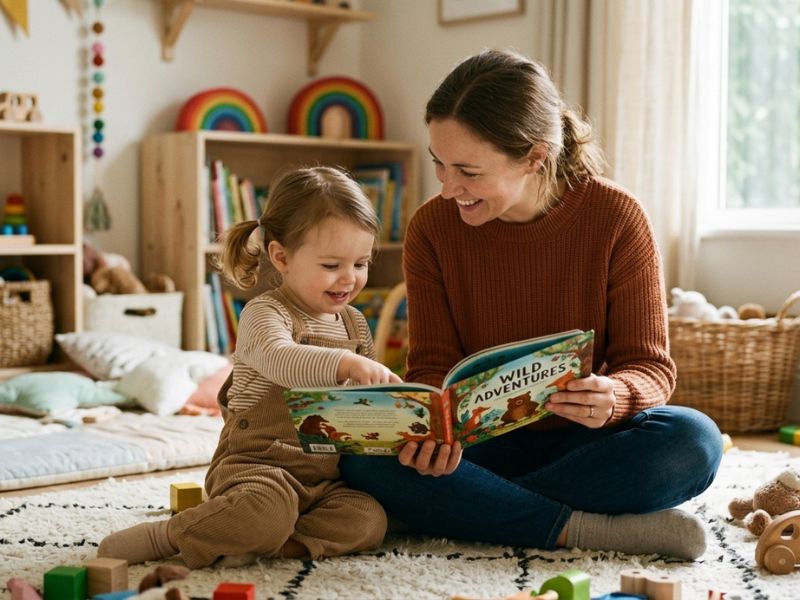
You don’t need to read every word on the page. With young toddlers especially, it’s often better to follow their interest — point at pictures, name what you can see, make the sounds of the animals, talk about what’s happening. The conversation around the book is as valuable as the text itself.
Board books with simple, repetitive text are ideal for toddlers who are building early language. Repetition is important — hearing the same words and phrases again and again is how toddlers learn them.
Sing Songs and Rhymes
Nursery rhymes and songs are brilliant for language development because they use rhythm and repetition to make words memorable. The predictable structure of a song also gives children a safe opportunity to join in — many children who aren’t yet producing much spontaneous speech will happily fill in the last word of a familiar rhyme.
Pause before the final word of a familiar song and wait to see if your child fills it in. “Twinkle twinkle little…” Leave a beat. This technique — often called a pause prompt — is widely used by speech and language therapists and works well at home too.
Build in Lots of Repetition
Toddlers need to hear a word many times before they’re ready to use it themselves. Repeating words consistently and in context — the same word for the same thing, every time — is more helpful than trying to introduce lots of new vocabulary at once.
If your child is working on animal names, spend a week focused on those. Use them during play, during books, during bath time. The repetition builds familiarity and makes the word easier to retrieve when your child is ready to use it.
Use Simple Language
When talking to your toddler, aim to use language that’s just slightly above their current level — not far above it. If your child is using single words, model two-word phrases. If they’re using two words, model short three-word sentences.
Long, complex sentences are harder for toddlers with speech delay to process. Keeping your language simple and clear gives them the best chance of tuning in to what you’re saying.
Make Time for Back and Forth Interaction
Any back and forth exchange — even without words — builds the foundations of communication. Taking turns in play, copying each other’s sounds and actions, responding to your child’s gestures and vocalisations as if they’re meaningful communication — all of this matters.
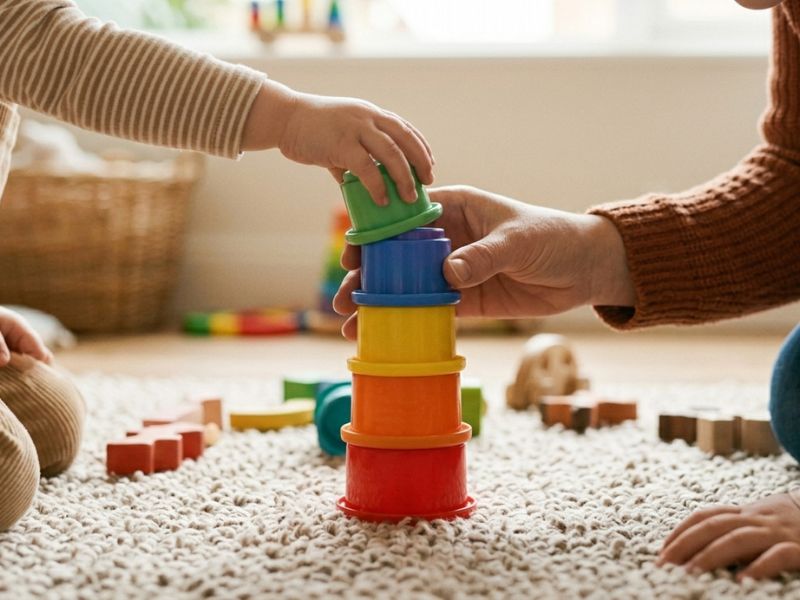
If your child points at something, respond to the point: “Yes, that’s the cat. The cat is sitting on the wall.” If they make a sound, repeat it back and add a word. These exchanges build the conversational framework that language eventually fills.
Limit Screen Time
This isn’t about guilt — it’s just worth knowing that passive screen time doesn’t support language development in the way that real interaction does. Language is learned through live, responsive conversation, and screens can’t provide that in the same way.
If your child does watch television, watching together and talking about what’s happening on screen is far more valuable than leaving them to watch independently.
When to Seek Support
If your child is not meeting speech and language milestones for their age, please do speak to your health visitor or GP. You can also refer your child directly to NHS speech and language therapy services in many areas without needing a GP referral first — it’s worth checking what’s available locally.
Early intervention makes a significant difference to outcomes, and getting support doesn’t mean something is seriously wrong. It means you’re doing the right thing for your child.